

Data shows culture and structure drive 67% of AI’s business impact. Discover why sustainable enterprise adoption requires shifting focus from tool licensing to human enablement across the entire organization.
As AI enters every corner of our daily work, companies are looking for ways to adopt these tools and implement them at scale. Many companies are learning in real-time something that enablement professionals have known for years; changing people’s behavior, how they think about their work, and how they interact with their tools is far more difficult than selecting the right tech or building the tools themselves.
A few years ago, a mentor of mine encouraged me to read Chip and Dan Heath’s book “Switch”. One image from the book has stuck with me, and I’ve been thinking back to it more frequently as we see the pace of change increasing exponentially before our eyes. In the book, the authors describe a rider on an elephant. The rider represents the rational side of a person, the part that plans, sets direction, and is willing to do anything provided there is sufficient data to convince them that it’s the right path to take. The elephant, on the other hand, is the emotional and habitual side, the part that weighs whether trying something new feels safe or risky, especially when failure carries a cost and success isn’t expected to improve outcomes. The rider (or rational) might be able to influence the elephant (or emotional), but they will lose to the elephant every time, because no matter how hard the rider tries, the elephant is bigger, it’s stubborn, and doesn’t move unless it wants to and the path before it is clear.
Microsoft’s 2026 Work Trend Index surveyed 20,000 AI users and revealed that organizational factors, culture, manager support, and talent practices, account for 67% of AI’s real business impact. Individual mindset and behavior account for just 32%. In other words, whether an AI rollout actually generates a return on investment has much more to do with how the surrounding organization is built to support change than with how excited an individual worker is to log in and try it.
The same Microsoft report highlighted a more concerning dynamic: only 13% of AI users say they’re rewarded for reinventing how they work when the outcomes aren’t guaranteed to succeed. That statistic is easy to skim past, but it’s another reason why enterprise adoption stalls. When failure carries operational penalty and success carries no explicit reward, the emotional side reads the room correctly and stays put. Employees default to traditional methods, not because they weren’t convinced, but because nothing in the environment told them it was safe to move.
Matching the Data to Operational Reality
Our COO, Todd Myers, framed this challenge directly in an internal update: getting an AI tool adopted into daily operations requires far more long-term effort than the engineering work required to ship it.
Change management is inherently complex, but friction drops dramatically when teams understand the overarching vision and feel bought into where things are headed. When there is no fear attached to role evolution, and when leadership actively supports sensible risk-taking, that’s when the emotional and rational are ready to walk the path together.
Fluency Is Never Evenly Distributed
Across any enterprise, user fluency follows a predictable curve:
- Power Users (~10%–20%): Early adopters who picked up the tools, taught themselves, and naturally pioneer new use cases.
- Fast Followers (~30%–40%): Practical users who jump in once a peer demonstrates proven value and sees how their success is rewarded.
- Guided Users (~40%–50%): Core team members who require structured enablement, clear guidelines, ongoing training, and more assurances before AI becomes part of how they work.
Most corporate AI rollout strategies are designed by power users for power users, meaning they cater to employees who are already aligned on the emotional side and ready to move. Sustainable organizational transformation requires building enablement programs specifically for the remaining 80%, where the job isn’t to argue harder, it’s to simplify the ask and clear the path.
The Three-Question Framework
So, how do you clear the path? An effective exercise that has resonated with me is to ask yourself (or your teams) three questions:
- Is there anything you really wish you could spend more time on in your job, the work that directly creates value for you or your stakeholders? Think of the things that have been on your to-do list for a long time but you never get to fully focus on.
- What are the necessary, repetitive tasks consuming your schedule that you wish you didn’t have to spend as much time on?
- What does my job/team/organization/company look like if I’m able to spend most of the time on the answer to question 1, without having to sacrifice the answer to #2?
What often starts to bubble up is a desire to diminish the data entry parts of a job to focus more on the strategic, interesting, or engaging parts of the job. That’s a path that people are generally interested in walking once they know the path is there, it’s clear, and the only things waiting for them on the other side are more interesting, engaging projects rather than a jump-scare.
A Direct Strategic Directive
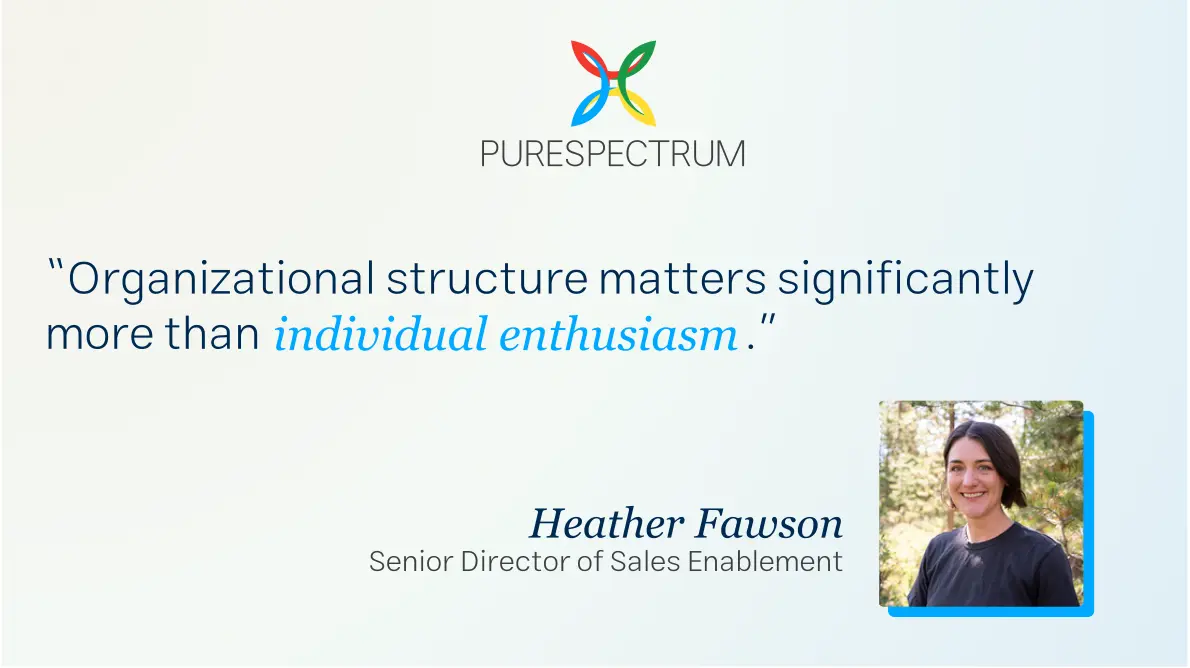
If the organizational environment dictates twice as much of AI’s success as individual motivation, then any enterprise only investing its focus and budget on software and tech rather than enablement is investing entirely in the rational and hoping the emotional follows along for free.
A smart organization will seriously invest time, focus, and resources in the human side of an AI rollout, as if it were as important as the tools themselves, because according to the data, it is.
This is the second post in an ongoing series on how PureSpectrum has approached AI adoption. Read the first post on our three-phase rollout framework: Explore, Scale, Efficiency, and the third on what human-in-the-loop governance actually looks like day to day.

Heather Fawson
Senior Director of Sales Enablement