

Something has shifted in how research gets done, and it has shifted faster than most platforms have been willing to acknowledge. A 2025 study by the Market Research Institute International found that 62% of market research professionals are now using AI in their work, up from just 40% the year before. A 2026 Elsevier global survey of 3,000 researchers found that 58% now use AI as part of their standard workflow, up from 37% just two years ago. A separate METR study of 349 technical workers found that researchers and academics report a median 1.4 to 2x increase in the value of their work as a direct result of AI tools. These are not marginal gains. This is a workflow that has made its way into the daily lives of researchers.
Researchers are designing studies, framing methodology, and building screeners inside AI environments like Claude, and then leaving that environment entirely to log into a separate platform, enter their requirements, and get a study into field. For a broader view of how this AI-driven shift is also reshaping agency and holding company strategy, data is the strategy for agencies too covers this in detail. It is a break in a workflow that should be seamless, and it is exactly the kind of friction PureSpectrum was built to solve.
What the Connector Does
With the PureSpectrum Connector for Claude, a researcher can describe their study in natural language, add their survey link, and launch directly into the PureSpectrum Marketplace without ever leaving Claude. The connection is private and secure, and what sits behind it is the same respondent quality infrastructure our clients have relied on for years. This is not a stripped-down interface or a simplified version of the platform. It is a direct path into our full sample marketplace, covering 125+ countries and millions of survey takers, accessible from the environment researchers are already working in.
Why We Built This
The right moment to reach a researcher is when they are already working, not when they have stepped away to open another tab. By the time a researcher is ready to launch a study, they are already deep inside an AI workflow. The context-switch to get into field was not just inconvenient. It was interrupting the most productive part of their process.
That pattern holds across the profession. Academic researchers have been particularly visible early adopters: according to the Elsevier survey, 61% now use AI to discover and summarize literature, 51% rely on it for literature reviews, and 41% use it to draft grant proposals. A 2026 Frontiers survey of 1,600 academics found that more than 50% have brought AI into peer review. Every one of those entry points sits upstream of fielding a study.
We built the connector to close that gap, because researchers are not waiting for platforms to catch up to AI. They are already working inside it, and they expect the tools they depend on to meet them there.
What That Looks Like in Practice
Closing the gap is not a single feature. It shows up in the everyday moments where the connector saves researchers and project managers the most time. Across this series, we walked through three of them.
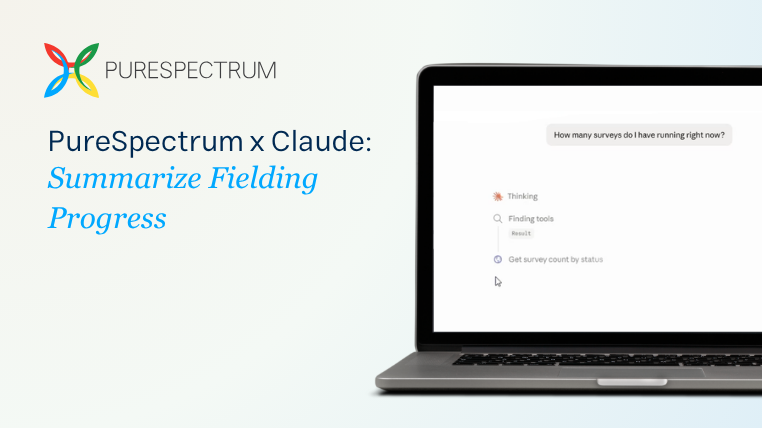
Summarizing fielding progress turns a morning of clicking through projects into one question, with Claude pulling pacing across your whole account and flagging what needs attention. Boosting sample to underperforming projects collapses two workflows into one, so the moment you spot a lagging study, you can launch fresh traffic, reallocate suppliers, or open the cells that are behind, all in the same conversation. And closing out projects keeps the last mile clean, with reconciliation, an audit-ready record, and a confirmation step before anything is final.
Each one takes a task that used to mean leaving Claude and navigating the platform, and turns it into something you can simply ask for. The individual time savings matter. What matters more is that the gap between where researchers work and where they field is closing.
This Is How We Build
PureSpectrum has a habit of building toward where researcher behavior is heading before it becomes the obvious move. When we developed PureScore™, we were the first to track respondent behavior longitudinally regardless of source, because we believed quality had to be something earned and re-earned in real time. The myth of the instant AI survey taker explores why longitudinal respondent tracking matters more than ever as AI-assisted fraud becomes more sophisticated. The connector for Claude comes from the same instinct. Researchers are already working inside AI environments, and our goal is for PureSpectrum to be the natural next step in that workflow, not something that pulls them out of it.
That means continuing to invest in the infrastructure behind the interface: respondent scoring, global supply, data security, and new entry points as researcher behavior keeps evolving. The connector is one of those entry points, and it will not be the last. These capabilities are also supported through our market research services, helping researchers access reliable data and execute studies more efficiently.
Sources
Market Research Institute International (MRII), “AI in Focus 2025: How Market Researchers Are Embracing and Adapting to Generative AI,” 2025 (n=426 market research professionals globally)
Elsevier, “Researcher of the Future: A Confidence in Research Report,” 2025 (n=3,200 academic and corporate researchers globally)
METR, “AI Assistance Value Survey,” Feb–Apr 2026 (n=349 technical workers)
Frontiers, AI in Peer Review Survey, 2026 (n=1,600 academics)
Learn More